From zoomies to slow blinks, here are 10 quirky cat behaviours explained..
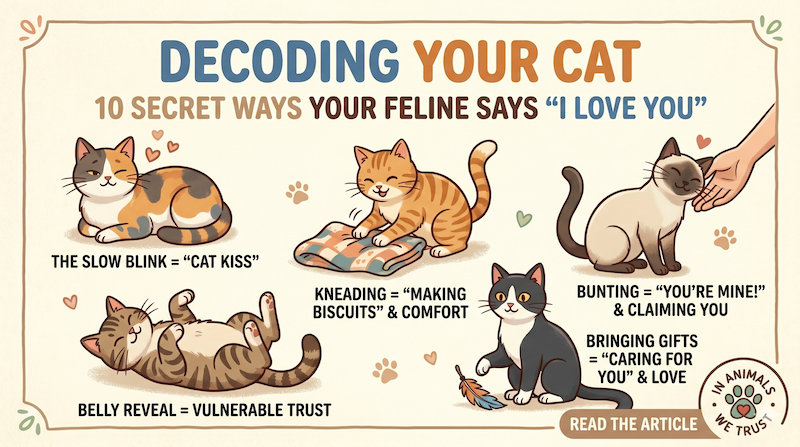

We’ve all been there: one minute your cat is a peaceful loaf of bread on the sofa, and the next, they are sprinting across the hallway like they’re training for the Olympics. Cats are wonderfully mysterious creatures, and while their antics keep us laughing, they are often trying to tell us something important!
Understanding the why behind the wiggle helps us build a stronger, more compassionate bond with our feline friends. When we learn to speak their body language, we create a home where they feel truly seen and safe.
Here is a deeper look into the science, psychology, and evolutionary history behind each of these fascinating feline behaviours.
In the animal kingdom, direct eye contact is almost always a challenge, a threat, or a prelude to an attack. When a cat looks at you and slowly closes their eyes, they are doing something incredibly vulnerable: they are actively choosing to block out their surroundings and lower their guard in your presence. By dropping their eyelids, your cat is communicating that they do not perceive you as a threat, nor do they wish to threaten you. It is the ultimate compliment of absolute safety, mutual comfort, and deep affection—which is why behaviourists beautifully refer to it as the "cat kiss."
Scientifically known as Frenetic Random Activity Periods (FRAPs), the zoomies are a sudden, explosive release of pent-up physical and mental energy. In the wild, cats are ambush predators; they spend hours quietly conserving their energy for short, intense bursts of stalking, chasing, and pouncing. In a domestic setting where food is readily provided, that raw, biological energy accumulates. When the threshold is reached, it triggers a magnificent, unprompted sprint across the house. It is a completely healthy, natural manifestation of a happy, active feline processing their predatory instincts.
This rhythmic, alternating pawing motion is one of a cat's earliest instinctual behaviours, originating just hours after birth. As tiny kittens, they instinctively knead their mother's mammary glands to stimulate milk flow during nursing. Because this action is hardwired alongside the warm, safe, and deeply comforting emotions of early kittenhood, adult cats carry the habit forward into maturity. When your cat kneads a soft blanket, a pillow, or your lap, they are regressing to that blissful state of absolute contentment, signalling that they feel completely nurtured and secure.
While it looks and feels like a gentle nudge of pure affection, head bunting is actually an intricate territory-marking ritual. Cats possess complex scent glands concentrated around their cheeks, chin, lips, forehead, and the base of their tail. These glands produce unique pheromones that carry the cat's specific "signature scent." When a cat bumps their head against your face, hands, or furniture, they are transferring these pheromones onto you. Far from being a selfish act, they are claiming you as a safe, trusted part of their personal family ecosystem, essentially wrapping you in a comforting olfactory hug that says, "You belong to me."
A cat's underbelly houses all of their most vital, vulnerable organs, and a lack of protective ribbing makes it an evolutionary target for predators. Therefore, when a cat drops to the floor and rolls over to show you their stomach, it is a profound declaration of trust—they feel so safe in your presence that they are willing to expose their most defenceless zone. However, this is where many humans misinterpret the cue. While a dog exposes their belly as a submissive invitation for rubs, a cat's belly reveal is often strictly a visual boundary test. Touching the exposed belly triggers a defensive reflex, causing them to clamp down with claws and teeth. Look, appreciate the trust, but tread very lightly on the actual tummy rubs!
If you’ve ever watched your cat stare out the window at a sparrow while making a strange, chattering or clicking sound with their jaw, you are witnessing a fascinating mix of biological frustration and intense focus. Behaviourists believe this unique vocalisation is an instinctual reflex tied to the hunting sequence. It represents a surge of adrenaline when a cat spots prey but is physically blocked from reaching it (such as by a pane of glass). Some evolutionary biologists even suggest the rapid jaw movement mimics the "fatal bite" a feline would use to quickly dispatch prey in the wild, showcasing just how deeply rooted their wild ancestry remains.
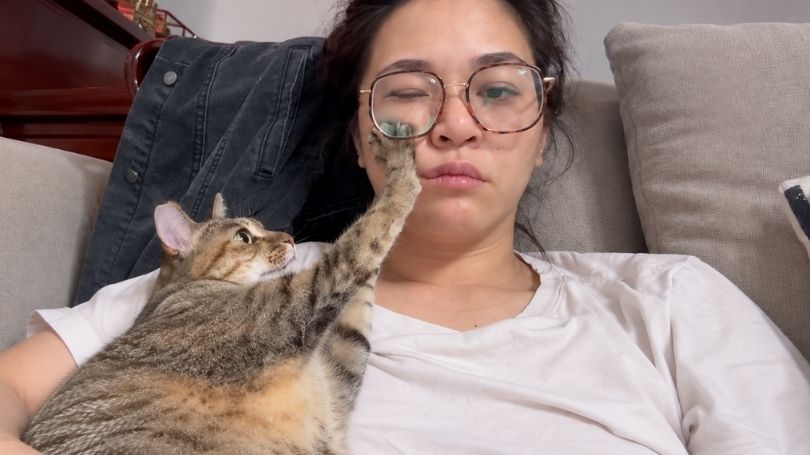
Whether it is a freshly caught mouse, a crunchy leaf, or a crinkly plastic toy, a cat bringing objects to its feet is an extension of their natural social structure. In the wild, mother cats bring disabled or dead prey back to the nest to teach their kittens how to eat and hunt. When an indoor cat presents you with their "kills," they are treating you as an honorary, highly valued member of their colony. Because you never seem to hunt for yourself, your kitty is stepping up to the plate, sharing their successful bounty to ensure the favourite human of their household is well-fed and cared for.
A cat's ears are marvels of biological engineering, controlled by over 32 independent muscles that allow them to swivel up to 180 degrees. When you see those ears rotating back and forth like mini radar dishes, it indicates a massive amount of cognitive processing. Forward-facing, upright ears show a relaxed, confident curiosity. When they begin to rapidly twitch, flatten slightly, or turn outward like aeroplane wings, it means the cat is rapidly assessing a sound, growing overstimulated, or feeling a wave of irritation. It’s a vital visual gauge that tells you exactly when to engage and when to give them space.
A cat’s tail is the ultimate mood barometer, and understanding its position is the easiest way to read their mind. When a cat approaches you with a high, vertical tail that finishes with a gentle, soft curve at the very top—resembling a question mark—it is a visual green light. This specific shape indicates a highly approachable, confident, and friendly emotional state. It is the feline equivalent of an open, enthusiastic smile and a casual "Hey, friend, let's hang out!"
It is a common misconception that cats are entirely nocturnal creatures. In reality, felines are crepuscular, meaning their internal biological clocks are hardwired to maximise activity during the twilight hours of dawn and dusk. In the wild, this is when their natural prey (like small rodents and birds) is most active, and when the dim lighting gives predatory cats a distinct visual advantage. Even though domestic cats don't need to hunt for survival, their internal evolutionary alarms still go off at these specific transitions of light, resulting in intense bursts of erratic, playful energy right as you are trying to sleep or wake up.
Does your cat have a signature weird move that didn't make the list? Tell us about your kitty's funniest habit in the comments below! Also, check out our latest video compilation on the In Animals We Trust YouTube channel to see these behaviours in action!

Cat lover from Thailand.
All Rights Reserved © 2026